There is a certain modest charm to red nettle, a plant often overlooked beneath the grander sweep of meadow flowers and woodland blooms. Yet, if you pause and look closely, you will find in it a richness of history, usefulness, and quiet beauty that has long been woven into the fabric of the British countryside.
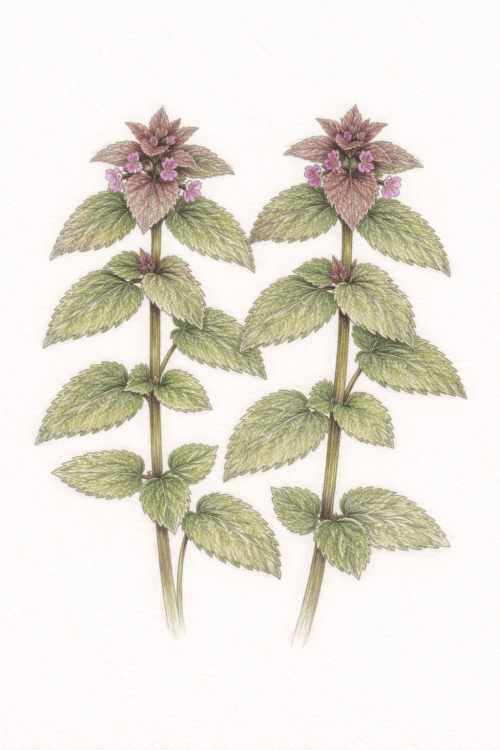
Botanical Name and Features
Red nettle is commonly known as red dead-nettle, with the botanical name Lamium purpureum. Despite its name, it is not a true nettle and does not sting.
This low-growing annual belongs to the mint family and carries many of its defining features:
- Soft, slightly hairy leaves with a rounded, heart-like shape
- Upper leaves flushed with a deep reddish-purple hue
- Square stems, typical of the mint family
- Small, tubular flowers in shades of pinkish-purple, clustered near the top
Its delicate flowers are particularly attractive to early pollinators, offering nectar at a time when few other plants are in bloom.
Description and Habitat
Red nettle thrives in disturbed soils and is a familiar sight along:
- Field margins
- Hedgerows
- Garden borders
- Roadside verges
It favours fertile, well-drained ground and can be seen from late winter through to autumn, often one of the first green presences to emerge after the cold months. Its resilience allows it to flourish in both rural and urban environments, quietly stitching together the seasons.
A Brief History
Though rarely celebrated in grand botanical texts, red nettle has long been part of everyday rural life. It was once gathered casually as a spring green, particularly when other food sources were scarce. In cottage gardens and smallholdings, it grew unbidden, yet seldom unwelcome.
Historically, plants like red nettle were valued not for rarity, but for reliability. They formed part of a broader tradition of foraging and herbal knowledge passed quietly through generations—knowledge that recognised worth in what grew close at hand.
Advantages and Disadvantages
Advantages
- Non-stinging: Unlike true nettles, it is safe to handle
- Early nectar source: Supports bees and other pollinators
- Edible: Young leaves can be used in cooking
- Abundant: Widely available and easy to identify
Disadvantages
- Often dismissed as a weed: Can spread readily in gardens
- Mild flavour: Less distinctive than other wild greens
- Short-lived: As an annual, it requires reseeding each year
Uses and Recipes
Red nettle is a gentle, versatile plant in the kitchen, best used when young and tender.
1. Red Nettle Soup
Ingredients:
- A handful of young red nettle leaves
- One onion, finely chopped
- One potato, diced
- Vegetable stock
- A knob of butter
- Salt and pepper
Method:
- Soften the onion in butter over low heat.
- Add the potato and stock, simmer until tender.
- Stir in the nettle leaves and cook briefly (2–3 minutes).
- Blend until smooth and season to taste.
The result is a mild, green soup with a subtle earthiness—comforting and nourishing.
2. Wild Leaf Salad
Young leaves can be added raw to salads:
- Combine with rocket, chickweed, or baby spinach
- Dress lightly with lemon and oil
Their softness lends well to mixed greens, adding both texture and interest.
3. Herbal Infusion
Though not as robust as some herbs, red nettle can be steeped:
- Use fresh leaves
- Pour over hot (not boiling) water
- Leave to infuse for 5–10 minutes
The flavour is gentle, almost grassy, and best enjoyed as a light spring tonic.
Suggestions for Gardeners and Foragers
- Allow a small patch to grow undisturbed to support pollinators
- Harvest sparingly and only from clean, untreated areas
- Pair with stronger-flavoured herbs when cooking
- Observe its growth—it often signals healthy, fertile soil
Rather than removing it entirely, consider its place within a more balanced garden ecosystem.
Folklore and Old Sayings
Though not as storied as some herbs, red nettle shares in the quiet folklore of hedgerow plants. It is sometimes said:
“Where the nettle grows, the earth is kind.”
And in rural tradition, early spring greens—including red nettle—were thought to “wake the blood” after winter’s heaviness.
A simple verse, once murmured in country lanes, captures its humble presence:
“Among the hedge and by the way,
A purple crown greets spring’s first day.”
A Plant Worth Noticing
Red nettle may not command attention at first glance, yet it offers much to those who look more closely. It feeds bees when little else will, nourishes quietly, and reminds us that usefulness often lies in the most unassuming places.
In a landscape that changes with the seasons, it stands as a gentle constant—rooted, generous, and quietly enduring.
Further Reading: Foraging in April: Return to the Hedgerows, What’s in Season in April, Hemlock: A walker’s guide to Britain’s beautiful but deadly plant
Inspiration: Instagram, TikTok, Threads, Pinterest, Twitter, BlueSky