








There is a quiet generosity to the dandelion. By late April, when the hedgerows are still gathering themselves and the trees only just finding their full leaf, the dandelion is already here in abundance — bright, insistent, and unapologetically golden.
Often overlooked or dismissed, it is in fact one of our most useful and symbolic wild plants. The dandelion carries the sun in its flower, the moon in its clock, and the stars in its drifting seeds — a small universe at our feet.
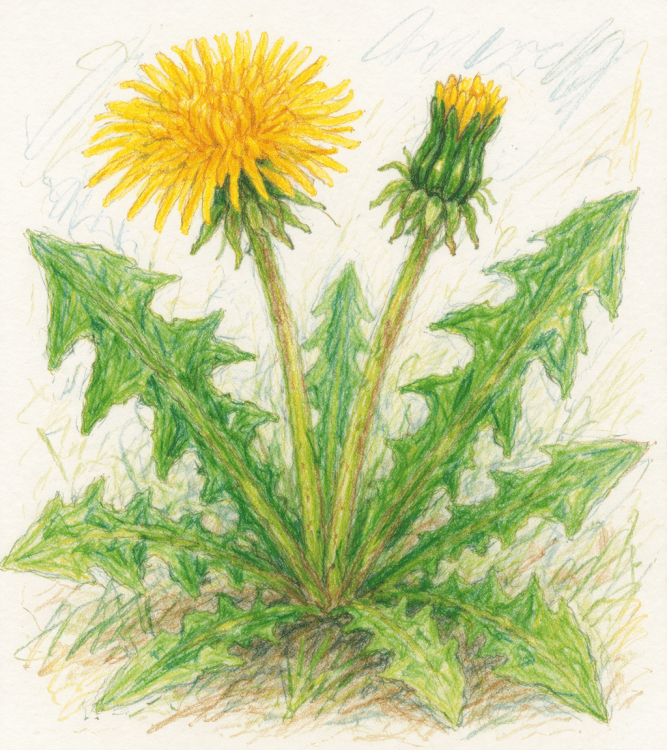
Botanical notes and history
The dandelion (Taraxacum officinale) is a hardy perennial with a deep taproot, jagged leaves forming a low rosette, and hollow stems that exude a milky sap when broken. Its bright composite flowers open with the sun and close at dusk, responding quietly to the rhythms of the day.
Its name comes from the French dent de lion — lion’s tooth — a reference to the sharply toothed leaves. Long before lawns were clipped and controlled, the dandelion was a valued plant in monastery gardens and cottage plots, used for both nourishment and medicine.
Nutritional value
Dandelion leaves are deeply nourishing. They contain vitamins A (as beta carotene), C, E, K and B6, alongside folate, thiamine and riboflavin. Mineral-rich, they provide potassium, calcium, iron and manganese.
Combined with nettles, they create a potent, revitalising food — one that supports the body at a time of seasonal transition. Traditionally, dandelion has also been used as a gentle diuretic, supporting the body’s natural cleansing processes.
Eating the season
At this time of year, every part of the plant can be used:
- Leaves and petals can be scattered through salads, bringing a pleasant bitterness that balances richer foods.
- Leaves can be added to stir-fries or dried for later use in tinctures and teas.
- Flowers and leaves can be brewed with nettle and cleavers in a teapot for a fresh, green spring infusion.
- Unopened buds can be pickled, offering a caper-like sharpness.
- Whole flowers can be dipped into batter and fried as delicate fritters.
- Stems, hollow and surprisingly sturdy, can even serve as natural straws.
When drying flowers, always place them sepal side up — otherwise they will quickly transform into their familiar clocks.
In the kitchen
Dandelion fritters
Dip whole flower heads into a light pancake batter and fry until crisp and golden. The petals soften slightly, lending a subtle honeyed flavour.
Dandelion pesto
Blend a handful of young leaves with garlic, nuts (walnuts or pine nuts work well), grated hard cheese, lemon juice and olive oil. A vivid, slightly bitter pesto, perfect with bread or pasta.
Dandelion chips
Toss leaves lightly in oil, spread on a tray and bake until crisp. A simple, savoury snack with a gentle bitterness.
Drinks of the season
Dandelion wine
A traditional country wine, light and floral.
- 1 large bowl of dandelion flowers (green parts removed)
- 4 litres water
- Zest and juice of 2 oranges and 1 lemon
- 1 kg sugar
- Wine yeast
Pour boiling water over the flowers and leave to steep for 2–3 days. Strain, add citrus and sugar, then allow to cool before adding yeast. Ferment in a demijohn for several weeks, then bottle. Leave to mature for a few months — if you can wait — for a clear, golden wine that captures the essence of spring.
Dandelion mead
A richer, honeyed variation.
- 1–2 handfuls dandelion flowers
- 1 litre water
- 250–300 g honey
- Juice of half a lemon
- A pinch of yeast
Warm the water and dissolve the honey. Add flowers and lemon, allow to cool, then add yeast. Ferment slowly, then bottle and age. The result is softly floral with a gentle sweetness.
Dandelion soda
- 2–3 handfuls flowers (green parts removed)
- 1 litre water
- Juice of 1 lemon
- 2–3 tbsp sugar or honey
Steep flowers in warm water, strain, then add lemon and sweetener. Leave loosely covered for a day or two to develop a light natural fizz, then chill.
The roots: hidden depth
Beneath the surface lies the dandelion’s taproot — long, strong, and full of stored energy. Dug in early spring or autumn, the roots can be used in several ways.
Roasted dandelion root (coffee substitute)
Wash and chop the roots, then roast slowly in a low oven until dark and fragrant. Grind and brew as you would coffee. The flavour is deep, earthy and gently bitter.
Dandelion root decoction
Simmer chopped fresh or dried roots in water for 15–20 minutes. Strain and drink as a warming tonic, traditionally used to support digestion.
The roots can also be dried and stored for tinctures, preserving their properties for later use.
A plant of meaning
Few plants carry such quiet symbolism. The dandelion reflects the cycles of nature — bright as the sun in bloom, pale and luminous as the moon in seed, scattering stars across the air with every breath of wind.
As one saying goes:
“Every breath is a second chance — like the dandelion that blooms again.”
And another:
“Blow the seeds and let your wishes take root where they may.”
A final note
To walk through a garden or meadow in late April is to see the dandelion at its peak — not as something to be removed, but as something to be gathered, used and appreciated.
It offers nourishment, medicine, and a reminder of abundance — freely given, if we choose to notice it.
Further Reading: Favourite Books for Thrifty Living and Honest Food, Eat Well for Less: Shop Smart, Cook Better, and Cut Waste, Foraging in April: Return to the Hedgerows, What’s in Season in April
Inspiration: Instagram, TikTok, Threads, Pinterest, Twitter, BlueSky