There is something rather satisfying about growing a plant that does more than simply look good. Woad is one of those rare additions to the garden — modest in appearance, yet capable of producing one of the most enduring and sought-after colours: blue.
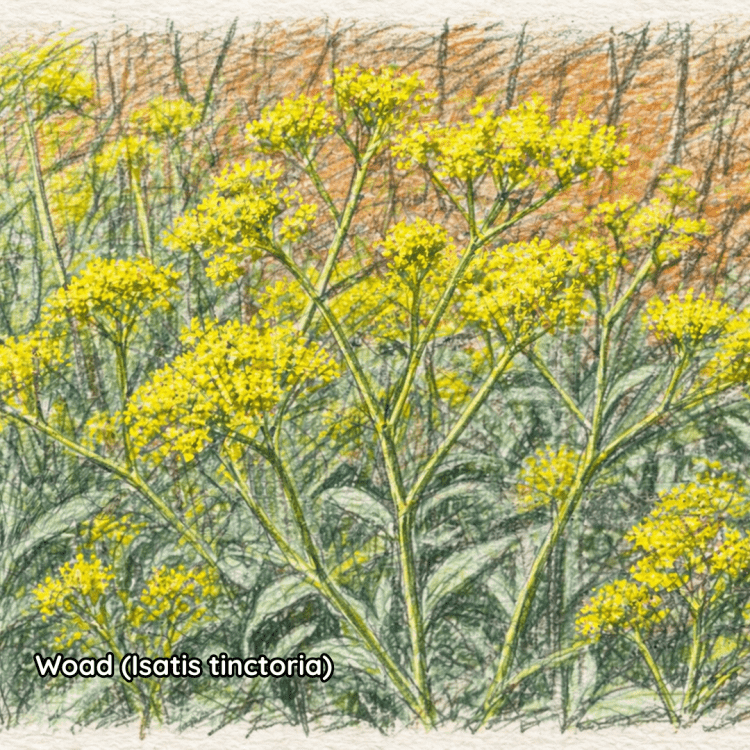
At a glance, it’s easy to overlook. In its first year, woad forms a low rosette of soft, grey-green leaves. In its second, it rises into tall, airy stems topped with small yellow flowers. And yet, despite those bright yellow blooms, it is the leaves that hold its secret — the source of a surprisingly rich blue dye.
A plant of quiet transformation
Woad belongs to the brassica family and shares the same resilient, unfussy nature. It grows well in ordinary soil, copes with dry spells once established, and asks for little attention.
What makes it remarkable is not how it grows, but what it becomes. The blue pigment isn’t visible in the plant itself — it only appears through process. Leaves are harvested, soaked, and exposed to air, and slowly the colour emerges. Green turns to blue, almost imperceptibly at first, and then with quiet certainty.
It’s this transformation that has fascinated growers and makers for generations.
Growing woad at home
Woad is straightforward to grow, making it well suited to both kitchen gardens and borders.
Sow seeds in spring, from March through to May, directly into a sunny, well-drained spot. The soil need not be rich — in fact, overly fertile ground can reduce the strength of the dye.
As seedlings appear, thin them to around 30–40cm apart. Woad develops a strong taproot, so it’s best not to disturb it once established. Keep the area weed-free in the early stages, and water during prolonged dry spells in its first year.
After that, it largely looks after itself. In its second year, it will flower freely, bringing height and a light, airy presence to the garden — and, if allowed, it may gently self-seed.
When to harvest for dye
For dyeing, it is the leaves of first-year plants that are most valuable. These can be picked from late spring through summer, when they are fresh and full of potential.
Harvest little and often, taking what you need while allowing the plant to continue growing. The leaves are best used straight away, as the dye compounds begin to diminish once they are cut.
From leaf to blue: how woad dye works
One of the most intriguing aspects of woad is the contrast between what you see and what you get. The plant is green, the flowers are yellow — and yet the dye is blue.
This is because the pigment is held in a colourless form within the leaves. It only becomes visible through a combination of heat, water and air. The process may feel unfamiliar at first, but it quickly becomes intuitive.
A simple method for dyeing cloth with woad
Working with fresh leaves is the most immediate way to begin.
Start by gathering a generous handful of leaves and tearing them into smaller pieces. Place them in a heatproof container and pour over hot water — not boiling, but just below. Leave them to steep for around ten to fifteen minutes. The liquid will turn green, with no sign yet of the final colour.
Strain out the leaves, keeping the liquid. Allow it to cool slightly, then stir or whisk gently to introduce air. This stage helps the dye develop.
Meanwhile, soak your fabric — natural fibres such as cotton, linen or wool work best — so that it is fully damp before dyeing. Submerge it in the liquid and move it gently to ensure even coverage.
When you lift the fabric out, it may appear green at first. As it meets the air, the colour begins to change. Slowly, it turns blue — deepening as it oxidises.
For a stronger shade, repeat the process: dip, lift, and allow the colour to develop in the air before returning it to the dye bath. Each immersion builds depth.
Finally, rinse the fabric in cool water and leave it to dry naturally.
Exploring other dye methods
Once familiar with the basics, there are other approaches that allow for greater depth and consistency of colour.
An alkaline dye vat, made using washing soda or lime along with a natural reducing agent, helps release more pigment from the leaves or prepared woad. This method can be used repeatedly and is well suited to larger projects.
More traditional methods involve fermentation, where leaves are processed and aged before being used. While slower, this approach reflects historic practices and can produce particularly rich tones.
Woad is also available in prepared powder form, offering a more convenient way to work with the dye while still achieving its characteristic soft blues.
A place in the garden
Woad is not a showpiece plant, but it earns its place in quieter ways. It brings height and movement in its second year, supports pollinators with its flowers, and offers something few other plants can: the ability to create colour directly from what you grow.
It’s a plant that rewards curiosity. Not just for how it looks, but for what it can do — and for the simple satisfaction of seeing a piece of cloth turn blue in your hands.
A lasting impression
There is a certain pleasure in growing something that has purpose beyond the garden bed. Woad offers that in abundance. From a handful of leaves, a pot of warm water, and a little time, it produces a colour that has been valued for centuries.
A yellow flower, a green leaf,
and yet a blue that stays —
drawn out by careful hands,
and patience over days.
In the end, woad is less about spectacle and more about discovery — a plant that quietly reveals its worth, one leaf at a time.
Further Reading: Foraging in April: Return to the Hedgerows, What’s in Season in April, Hemlock: A walker’s guide to Britain’s beautiful but deadly plant
Inspiration: Instagram, TikTok, Threads, Pinterest, Twitter, BlueSky