September is a month for looking into hedgerows.
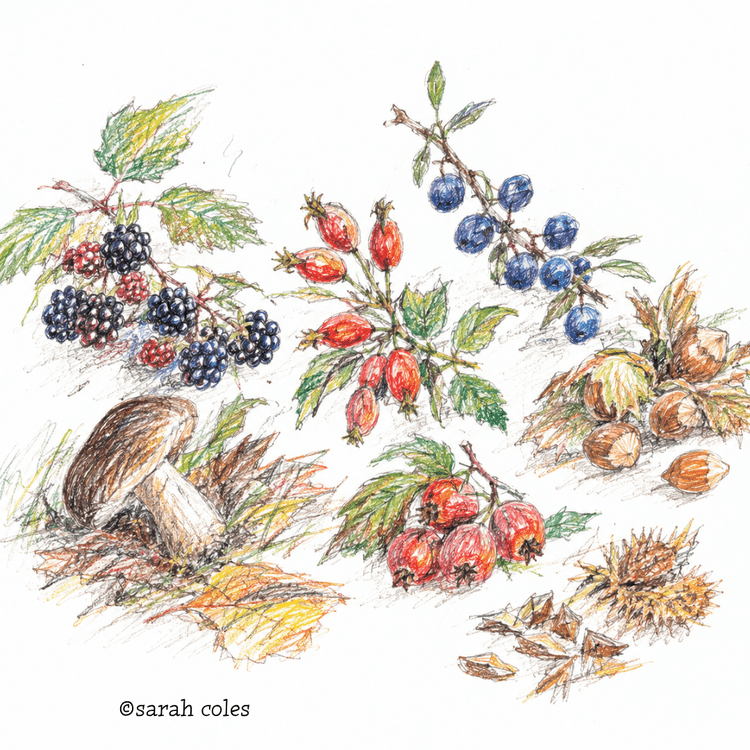
The extravagant greens of summer are beginning to soften, seed heads have replaced many of the flowers and, here and there, the first leaves are edged with yellow. Yet this is no quiet time in the countryside. Look more closely and the hedges are laden with fruit: blackberries darkening on brambles, rosehips shining scarlet among the thorns and elderberries hanging in heavy purple clusters.
Under the trees, another harvest is beginning. Hazelnuts are ripening, beech nuts are appearing in their prickly cases and, after rain, fungi push almost mysteriously through the woodland floor.
September is one of the richest months in Britain’s wild-food calendar. The Woodland Trust describes early autumn as an especially good time for foraging, with ripening fruits and nuts in hedgerows and trees and seasonal fungi appearing in damper woods.
But perhaps the real pleasure of September foraging is not how much you can collect. It is how much you begin to notice.
Before you pick anything: forage safely and responsibly
Never eat any wild plant, berry, nut or fungus unless you are completely certain of its identification and know that the part you are collecting is edible and has been prepared correctly. Some poisonous species resemble edible ones, and some otherwise edible wild foods are unsafe raw or in large quantities. Photographs, apps and online articles – including this one – should not be relied upon as your sole means of identification. Use a reputable, up-to-date field guide and, if you are inexperienced, learn from a knowledgeable forager or recognised expert. If there is any doubt at all, leave it where it is.
There are legal and environmental considerations too. The Woodland Trust notes that uprooting a wild plant without the permission of the landowner or occupier is illegal under the Wildlife and Countryside Act 1981, while certain species receive additional protection. Individual sites may also prohibit or restrict foraging, particularly where wildlife or vulnerable habitats are concerned. Check local rules and obtain permission where necessary.
Take only a small amount from abundant populations, don’t damage plants to reach their fruit, avoid trampling vegetation and leave plenty behind. Autumn berries, seeds and nuts are an important food source for birds, small mammals and other wildlife. A laden hedgerow isn’t simply a free pantry.
It is also sensible to avoid gathering food immediately beside busy roads, from obviously contaminated ground or from places where pesticides or other chemicals may have been used. Wash your finds before using them.
Be particularly cautious with fungi. Mushroom identification can be difficult even for experienced foragers and mistakes can have serious consequences. If you cannot identify a fungus with complete confidence, don’t eat it. The NHS advises seeking medical help immediately if you think someone has swallowed something harmful; call 111 if you are unsure whether something swallowed is harmful, and 999 or go to A&E in an emergency.
With those principles firmly in mind, September offers plenty to discover.
Blackberries
Blackberry picking is probably Britain’s most familiar form of foraging.
You don’t need specialist equipment or a journey into remote countryside. Brambles grow along footpaths, woodland edges, field boundaries and lanes, their arching stems carrying berries in every stage of ripeness.
September is prime blackberry time. The season generally stretches from late July into early October, with ripe fruit turning a deep purple-black.
A ripe blackberry should come away easily. If you have to tug at it, leave it for another day.
Blackberries provide fibre and vitamin C, while their dark colour comes partly from anthocyanins – naturally occurring plant pigments.
What to make: there is good reason blackberry and apple crumble has survived generations of September kitchens. The berries are also excellent in compotes, puddings, sauces and blackberry vinegar.
Or eat a few freshly washed berries just as they are.
Sometimes the simplest recipe is the best one.
Elderberries
The elder tree performs one of the loveliest transformations of the year.
Its frothy cream flowers belong to early summer. By September those same branches can be bowing beneath clusters of tiny, glossy, purple-black berries.
Elderberries generally appear from July to October, making September an excellent month to find them.
They have a deep, slightly earthy fruitiness and are traditionally used for syrups, wines and preserves.
There is an important distinction between elderberries and blackberries, however.
Elderberries must be cooked before eating. The Woodland Trust warns that raw elderberries are mildly poisonous and can cause stomach upset.
The ripe berries contain vitamin C and colourful anthocyanin plant compounds.
What to make: cook elderberries into syrup, cordial, jelly or compote. A small quantity also works beautifully with apples and blackberries in an autumn crumble.
It is a good fruit for preserving – a little September stored away for November.
Sloes
There are few better examples of a fruit improved by patience than the sloe.
Sloes are the fruit of blackthorn, one of Britain’s familiar hedgerow shrubs. By autumn the branches carry small, round, blue-black fruits with a powdery bloom that makes them look rather like miniature plums.
Indeed, they are relatives of the plum.
September is the beginning rather than the height of the sloe harvest. The Woodland Trust puts their picking season from around the end of September through to December.
Bite into one raw and its appeal may not be immediately obvious. Sloes are extraordinarily tart and astringent.
Traditionally they were gathered after the first frost, which helps soften the fruit. Picking ripe sloes and freezing them at home can achieve a similar result.
What to make: sloe gin is the famous choice, but sloes can also be made into jelly, jam, vinegar and chutney.
Blackthorn has formidable thorns, so this is one harvest best approached carefully.
Rosehips
Once the wild roses have faded, they leave behind one of autumn’s brightest fruits.
Rosehips glow orange and scarlet through September hedgerows and woodland fringes. Dog rose is particularly familiar, and its hips can be found from September into November.
The fleshy outer part of the fruit is notably rich in vitamin C. Rosehips became particularly important in Britain during the Second World War, when imported citrus fruit was difficult to obtain.
Inside each hip, however, are seeds surrounded by irritating hairs. These need to be removed or thoroughly strained from preparations.
What to make: rosehip syrup is the classic. The fruits can also be used for jelly, cordial and jam.
The colour alone makes them worth stopping to admire, even if you leave them untouched.
Hawthorn berries
Hawthorn is one of those trees that can become almost invisible through familiarity.
Its white spring blossom is followed in autumn by clusters of small red fruits known as haws. Look closely and they resemble tiny apples – appropriately enough, as hawthorn belongs to the rose family.
September is a good time to notice them as they deepen to a rich red.
Their flesh can be dry and rather unremarkable raw, but cooking transforms them. Their natural pectin also makes them particularly useful for preserves.
What to make: hawthorn jelly is traditional, but hedgerow ketchup is perhaps more interesting. Cook the haws until soft, strain carefully to remove the stones and combine the resulting pulp with vinegar, sugar and spices.
It is a pleasing transformation of a fruit that thousands of people walk past without noticing.
Crab apples
Not every apple found beside a footpath is a crab apple, but when you do find a genuine crab apple tree laden with fruit it can be a wonderful autumn sight.
The little apples vary considerably in appearance. Some are greenish-yellow, others gold, orange or flushed with red. What many have in common is an acidity that makes them considerably more useful in a saucepan than eaten straight from the tree.
That sharpness is part of their value.
Crab apples contain plenty of natural pectin, making them particularly useful for setting jellies and jams.
What to make: crab apple jelly is hard to beat. Its sweet-sharp flavour is excellent with cheese, roast pork and cold meats.
Crab apples can also be combined with blackberries, haws and other hedgerow fruits. Their pectin can help a mixed wild-fruit jelly to set.
Hazelnuts
Finding hazelnuts before the squirrels do requires either good timing or extraordinarily accommodating squirrels.
Hazel grows widely in British woods and hedgerows. By late summer and early autumn, clusters of nuts are developing inside their leafy coverings.
September is an excellent time to look for them. The Woodland Trust notes that hazelnuts generally ripen in late summer and early autumn.
As they mature, their outer coverings begin to peel back from the shell. Hazelnuts provide unsaturated fats, protein, fibre and vitamin E, along with minerals including magnesium.
What to make: toast them to deepen their flavour and scatter over an autumn salad, porridge or roasted vegetables. They are also excellent in cakes, biscuits and homemade nut butter.
But don’t harvest every nut from a productive tree.
Squirrels, mice and birds have been waiting for September too.
Beech nuts
Look beneath a mature beech from the middle of September and you may notice something among the fallen leaves.
Beech produces small, triangular nuts enclosed within distinctive bristly cases. These nuts are known as beech nuts or beechmast.
The timing is right for September: the Woodland Trust says the nuts can be found in their three-sided, bristly cases from mid-September through October, while beechmast can remain scattered beneath trees into November.
The crop can vary enormously from year to year. Every few years, beech trees may produce a particularly abundant crop – part of the phenomenon known as a mast year.
The little kernels can be roasted and used sparingly rather like pine nuts, perhaps scattered over an autumn salad or risotto.
There is an important qualification, however: beech nuts should not be eaten in large quantities. The Woodland Trust warns that they can be slightly toxic when consumed in quantity because of the tannins and alkaloids they contain.
This is therefore a wild food to sample modestly, not something to collect by the bagful.
Wild raspberries
A much less predictable September discovery is the wild raspberry.
Most raspberry fruit belongs to summer, but wild raspberries can continue into early autumn, so September berries are possible, particularly earlier in the month or where local conditions favour a later crop.
They are surprisingly widespread in Britain and can occur in open woodland, scrub, clearings and occasionally hedgerows. It can also be difficult to distinguish genuinely wild populations from cultivated raspberries that have escaped into the countryside.
Wild fruits are generally smaller than cultivated raspberries and often have a sharper flavour.
They are worth including in a September guide, but as a happy discovery rather than something you should expect to find. Blackberries are a much more characteristic and abundant September crop.
What to make: probably nothing elaborate. If you happen upon a few ripe fruits and are completely confident of their identification, enjoy them freshly washed with yoghurt or porridge.
A handful is quite enough to make the find memorable.
And then there are mushrooms
September rain can alter the woodland floor remarkably quickly.
Where yesterday there seemed to be little more than moss and fallen leaves, fungi suddenly appear beneath trees, beside paths and among decaying wood.
For experienced fungi enthusiasts, autumn can be one of the most absorbing periods of the year.
For the beginner, however, it is also where particular caution is needed.
Do not assume that a mushroom is edible because it resembles a photograph in a book, website or identification app. Never use colour, cap shape or a single characteristic as proof of identity. Some poisonous fungi can be confused with edible species, and the consequences of getting it wrong can be serious.
The Woodland Trust advises never consuming a wild fungus unless you are absolutely certain of its identification and specifically notes that fungi can be notoriously difficult to identify.
If you’re beginning to learn about fungi, there is no need to eat them at all.
Photograph them. Examine the cap. Look underneath without damaging them. Notice which trees are growing nearby. Learn the differences between gills, pores and spines.
Then leave them where they are.
Knowing the name of something can be every bit as satisfying as putting it in a frying pan.
A few things a responsible forager leaves behind
Good foraging isn’t measured by the weight of the basket.
Don’t pick rare or protected species. Don’t uproot plants. Don’t take fruit from a plant carrying only a handful. Don’t strip a productive bush simply because nobody else has reached it first.
The Woodland Trust recommends collecting only from plentiful populations, taking no more than you intend to consume and leaving enough for wildlife, plant regeneration and other foragers.
Remember, too, that permission matters. A public right of way gives you the right to pass along a route; it does not mean that everything growing beside it is yours to collect. Rules can also differ on nature reserves, protected sites and privately managed land.
There is a useful rule that encompasses much of this:
If you don’t know what it is, don’t eat it. If there isn’t much of it, don’t pick it. If you’re not sure you’re allowed to take it, leave it.
The pleasure of looking
Perhaps this is what foraging does best.
It changes the speed of a walk.
Once you recognise blackthorn, a hedge becomes more than a hedge. You remember where it flowered white in spring and return months later to find its branches carrying blue-black sloes. The elder whose blossom scented a June lane is suddenly heavy with berries. Beneath a familiar beech tree are strange little prickly cases you might previously have crunched underfoot without noticing.
Gradually, the countryside begins to acquire a calendar.
September’s pages are particularly colourful: purple-black brambles, scarlet rosehips, red haws, blue sloes and the warm browns of ripening nuts.
You don’t need to collect them all.
Take a small container, a reliable field guide and enough curiosity to stop every now and then. Perhaps you will come home with blackberries for a crumble, a few hazelnuts or simply a photograph of something new you have learnt to recognise.
Leave plenty in the hedge and beneath the trees.
After all, the September harvest belongs to the blackbirds, squirrels and mice as much as it does to us – and sometimes the most rewarding thing a forager can take home is simply the knowledge of what they have seen.
Further Reading: Autumn Foraging: Nature’s Harvest, The Art of Foraging: Discovering Nature’s Larder, Seasonal Living: A Year of Wellbeing, What’s in season in September? A guide to Britain’s early-autumn harvest, The Comfort of Homemade Food
Daily Inspiration: Instagram, Pinterest, Threads, Twitter, TikTok, BlueSky